 Passboards.
Guide · Clubs
30 supper club and cooking club ideas, and how to start one
By Max Khan, founder of Passboards · Updated
A supper club is the simplest good idea: a few friends, a regular date, and someone’s kitchen. It gets you cooking things you’d never make alone and seeing people you’d otherwise only text.
The hard part isn’t the cooking. It’s keeping it going after the third month. Good themes help, and so does a simple rhythm everyone can count on. Here are 30 ideas we like, grouped by how much effort they take, followed by a short guide to starting and running a club that lasts.
Easy themes (good for your first few nights)
- One cookbook. Everyone cooks a dish from the same book. The classic “cookbook club”, and a good way to find out which recipes actually work.
- One ingredient. Lemons, mushrooms, chickpeas, whatever’s in season. Every dish must feature it.
- Family recipes. Each person brings a dish from home and the story behind it.
- Colour dinner. Everything on the table is green, or red, or golden.
- Breakfast for dinner. Pancakes, shakshuka, congee, a full fry-up. Cheap and cheerful.
- Soup night. Everyone brings a pot; the host does bread. Perfect for winter.
- Dips and bread. Hummus, baba ghanoush, queso, tzatziki, a loaf or two. Very low stakes.
- Pantry challenge. Cook only from what’s already in your cupboard.
Themes with a twist
- Recreate a restaurant dish. Each person picks a dish they love eating out and tries it at home.
- Street food of one city. Mexico City, Bangkok, Istanbul, Naples. Small plates, eaten standing up.
- Blind swap. Everyone draws a name and cooks a dish that person loves.
- Mystery basket. The host buys three surprise ingredients; each pair of cooks must use all three.
- One pot or one pan. Everything cooked in a single vessel. Washing up is part of the fun.
- Decade dinner. 1970s dinner party: prawn cocktail, fondue, Black Forest gâteau.
- Film night menu. Cook the food from a film (Ratatouille, Big Night, Chef), then watch it.
- Same dish, five ways. Everyone makes their version of dumplings, or tacos, or ragù. Vote on nothing; compare everything.
- Around the world, one country per month. Rotate who picks the country.
- Grandparents’ kitchen. Recipes from an older generation, cooked from handwritten cards if you have them.
Bigger nights (a few times a year)
- Long table outdoors. Summer, a garden or park, everything served family-style.
- Harvest dinner. Visit a farmers’ market together in the morning, cook what you bought.
- Bake-off. Bread, pies or a single cake recipe; everyone’s attempt is on the table.
- Fermentation club. Start kimchi, sauerkraut or sourdough together, and eat the results at the next meeting.
- Pasta from scratch. One big session making dough and shapes by hand.
- Dumpling party. A production line of folding, then steaming and frying in batches.
- Holiday feast swap. Each person cooks a dish from a festival they grew up with.
- Cook-along with a guest. A friend who’s a great cook, or a parent, teaches one dish.
Low-effort nights (for busy months)
- Build-your-own. Tacos, bowls or pizzas: the host does bases, everyone brings a topping.
- Snacks and wine. A “tinned fish and bread” night counts.
- Takeaway tasting. Order from three places that do the same dish; compare.
- Leftovers potluck. After a holiday, everyone brings what’s left and turns it into something new.
How to start a supper club
Keep it small
Six to ten people is the sweet spot: enough for variety, small enough to fit round one table and talk. If more people want in, start a second club.
Pick a rhythm and stick to it
“First Sunday of the month” beats “whenever works”. A fixed rhythm means nobody has to organise from scratch each time, and people plan around it. Monthly suits most groups; every two weeks works for keen cooks nearby.
Choose a format
- Rotating host: one person hosts and cooks the main; guests bring starters, sides and dessert.
- Potluck: everyone brings one dish to a theme.
- Cook together: everyone arrives early and cooks as a team. Best for small kitchens and new cooks.
A few simple rules
- The host picks the theme and the date for the next one before everyone leaves.
- Say allergies and dietary needs once, up front, and plan around them every time.
- Split costs simply: bring a dish, or chip in for ingredients. Don’t keep score.
- Nothing has to be perfect. A failed soufflé is a better story than a good one.
Keep a record
Part of the pleasure of a long-running club is looking back: the first night, the dish everyone still talks about, the recipe you swore you’d make again. Take a photo of each dish and the table, write down what it was and who made it, and keep them all in one place.
Keeping the club going
- Send the next date the morning after. Momentum is everything.
- Share the recipes. Ask each cook to post theirs, even as a photo of the page.
- Welcome new people slowly. One guest a night keeps the feel of the group.
- Take a month off without guilt. Clubs survive breaks; they don’t survive dread.
Keeping your club’s nights in Passboards
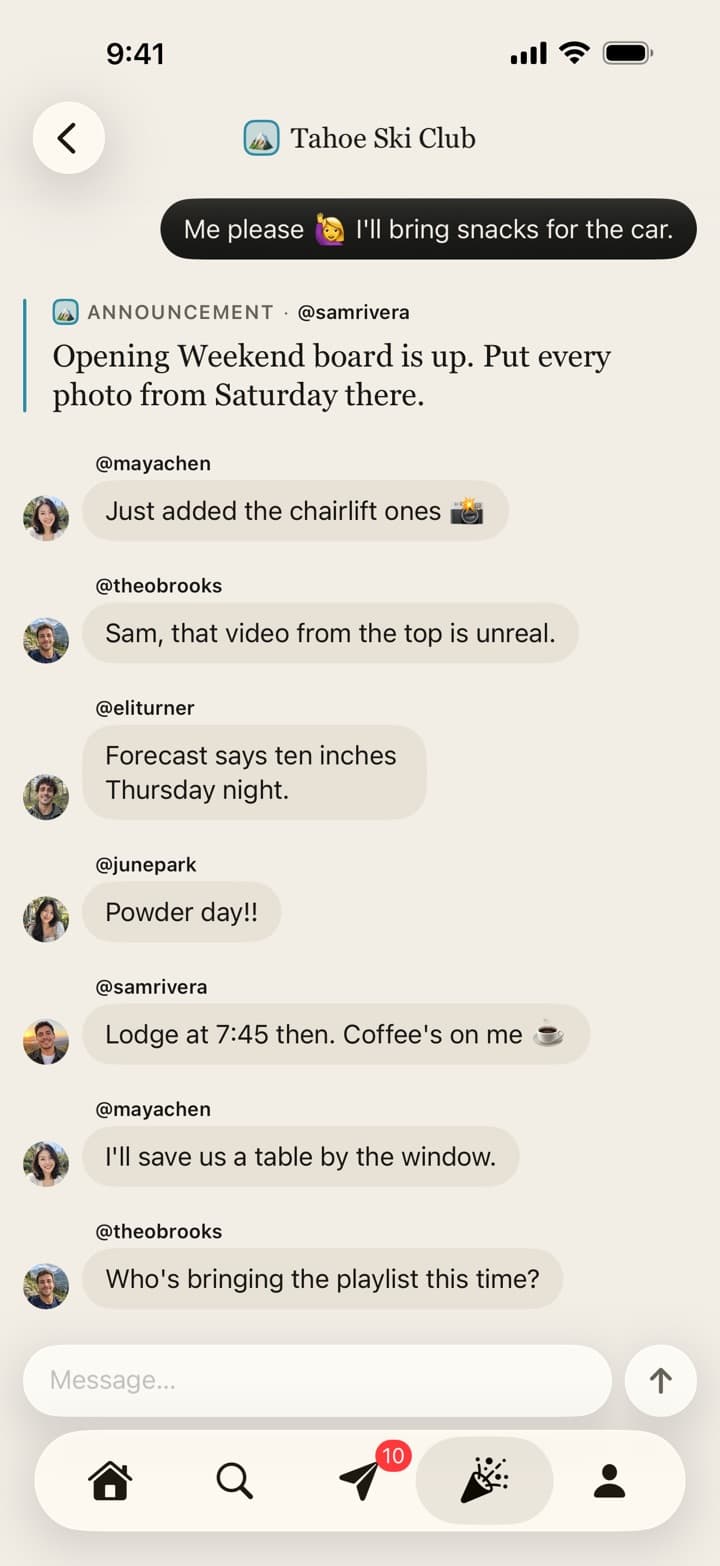
If your club is on iPhone, Passboards gives it a home. A club has a group chat, events with RSVPs for each dinner, announcements for “next theme is soup”, its own mark and a passboards.com/c/ address. Each dinner gets a board where everyone adds photos of their dish, the kitchen chaos and the table, with the recipe as a note or a longer write-up. See how it works.
- Pick Cooking (“The dishes, the kitchen chaos, the table”) when you make a board and it comes named and ready to invite. Share an invite link or QR code so new members can sign up and join straight from it.
- Export the whole board, with every caption and name, free. It’s the start of your club’s cookbook.
- Clubs and boards hold up to 100 members. Everyone who posts needs an account, made in the iPhone app (iOS 26 or later). Free, with no ads today. Stuck? The Help Center walks through every step.
Also running a club? See how run clubs use it.
Free for iPhone on iOS 26 or later. No ads today.
Common questions
What people ask.
What is a supper club?
A group of friends who meet regularly to cook and eat together, usually at one person’s home, often around a theme.
How many people should be in a supper club?
Six to ten is easiest: enough for variety, small enough to fit round one table.
How often should a supper club meet?
Monthly suits most groups. A fixed rhythm, like the first Sunday of the month, keeps it going.
What’s the difference between a cooking club and a cookbook club?
A cookbook club cooks from one chosen book each time. A cooking club can use any theme or format.
How do you split costs in a supper club?
Usually everyone brings a dish, or guests chip in for ingredients when the host cooks. Keep it simple and don’t keep score.
What are good supper club themes for beginners?
One cookbook, one ingredient, breakfast for dinner, soup night or dips and bread.
How can we keep photos and recipes from every dinner?
Keep one shared place for the club: a photo of each dish, what it was and who made it. In Passboards, each dinner can be its own board inside your club.